

NVDA King of Kings, GOOG Lord of Lords: The Race to the Top of the World
On November 21, 2025, the Fear & Greed Index sat at 14, Extreme Fear. Daniel Yue called NVDA the King of Kings and GOOG the Lord of Lords. NVDA is now at $204.70, up 4.173% on the day, with a market capitalisation of $4.775 trillion, the largest company on earth. GOOG sits at $389.91, up 1.468%, at $4.655 trillion, closing the gap. Samsung just crossed $1 trillion in market cap, joining TSMC in the elite club. The Fear & Greed Index today reads 69, Greed, up from 22 one month ago.
Daniel’s call stands: GOOG will surpass NVDA. They are running neck to neck. The 250-SMA on both is well below price, confirming the structural uptrend. For the full history of NVDA’s rise and the AI and semiconductor thesis, those editions remain the reference.
World Observation: Kardashev Type II Civilization and the 20-Year Thesis
Trump launched Project Freedom and halted it the second day. The market rose on launch. Then rose again on cancellation. This is the definition of a bull market: no matter the news, there is one direction only. Trump also called back F-35 fighters mid-flight in both January and March, each time after airborne evaluation confirmed insufficient military power. Daniel Yue draws the contrast with Operation Eagle Claw in 1979, Jimmy Carter’s failed Delta Force rescue of 66 American hostages in Tehran: six helicopters, a bus accident, desert mechanical failures, two helicopters crashing on the U-turn home. Trump’s approach is different: abort, reassess, prepare, try again. The Iran crisis is moving to the background. The economy returns to centre stage.
The question Daniel Yue poses is not what happens next month or next year. It is what defines the next two decades. The answer is Kardashev Type II Civilization: Space AI.
The Apollo programme was a sprint to defeat the Soviet Union. The Artemis programme is a permanent strategic competition. The objective is not a flag on the Moon but military occupation of low earth orbit and permanent bases on the Moon and Mars. China, the EU, Russia, UAE, Japan, and South Korea are all competing. First come, first served. The locations matter as much as the technology.
The investment thesis is not just SpaceX and rocket stocks. It is the entire chain: Blue Origin, ARKX, quantum computers, supercomputers, chips, foundries. Samsung chasing TSMC in the semiconductor supply chain. GOOG chasing NVDA in AI infrastructure. This is the space economy and Mars landing thesis made concrete. A new page turned on May 5th, the Start of Summer in Chinese Geomancy. Position for the decade, not the quarter.
Market Strategy: ETFs, Changing Horses, and the Golden Pit Problem
AI is not a bubble. But AI stocks are sometimes overvalued and due for correction. The correction has not come. Do not guess the top. Instead, use structure.
The current market has a peculiar character: indexes break record highs while individual stocks in those same indexes fall. This is changing horses. Money rotates rapidly between components. An investor holding last year’s winners may find their account shrinking even as the index rises. The solution is to own the index itself, not try to pick every component correctly.
Daniel Yue’s recommended ratio for this environment: 3 QQQ, 2 VOO, 1 DIA monthly. Or split across six months in three rounds. QQQ captures the NASDAQ technology leadership. VOO captures the broader S&P. DIA adds the industrial and financial weight of the Dow. Together they ride the index without betting on which horse wins the internal race.
The golden pit of April 2025 gave investors a deep, prolonged buying opportunity. The golden pit of April 2026 was shallower and shorter. Buffett’s warning about gambling sentiment is real. But waiting for a 2008 or 2020-scale correction is not a strategy. It is paralysis. The record high strategy and how to catch the bottom remain the frameworks for navigating this.
Global Round-Up: iPhone 17, OpenAI Smartphone, Jensen Huang, Ukraine
Apple’s iPhone 17 standard model topped global smartphone sales in Q1 2026, capturing 6% of all new smartphone sales worldwide. The standard version has overtaken the Pro series as the sales leader, signalling broad consumer demand rather than premium niche.
OpenAI has moved its AI agent smartphone mass production target from 2028 to the first half of 2027, driven by year-end IPO ambitions and intensifying competition in the AI hardware market. The AI smartphone race is accelerating faster than most forecasts assumed.
Jensen Huang spoke at the 2026 Milken Institute Global Summit and stated that China should not acquire NVDA’s latest generation chips to preserve US AI leadership. This statement captures NVDA’s precise dilemma: it wants back into the Chinese market, which it lost to export controls, but publicly it must support those same restrictions. Watch how this tension resolves as Trump navigates Beijing.
Ukraine provided evidence, confirmed by photographs in The Times and Sunday Times of London, verified as real and not AI-generated, that Russian soldiers have eaten dead human bodies in multiple locations. Russian officers have issued orders against the practice. Day 1534 of the Russia/Ukraine conflict.
WTI oil fell after Trump claimed peace talks were making good progress, then rose again after he threatened the strongest possible bombardment if Hormuz was not opened. Oil futures open interest has fallen to its lowest since August, with money flowing out of oil futures and into equities. Part of the fuel for the equity rally is former oil money finding a new home.
What Investors Should Do Now
- NVDA and GOOG are the two anchors: NVDA at $204.70 ($4.775T) and GOOG at $389.91 ($4.655T) are running neck to neck. Daniel Yue’s call is that GOOG surpasses NVDA. Both remain core holdings in the AI and semiconductor cycle.
- Build the Kardashev portfolio: Space AI is a 20-year thesis. SpaceX, Blue Origin, ARKX, quantum computing, chip foundries. Do not wait for the perfect entry. The race to occupy the Moon and Mars has no pause button.
- Use the 3-2-1 ETF ratio: In a changing-horses market, own the index. 3 QQQ, 2 VOO, 1 DIA monthly. Rotate across three rounds over six months. This removes the individual stock selection risk while riding the bull.
- Samsung joining the $1T club matters: Samsung at $1.206 trillion is closing on TSMC. Korean and Taiwanese semiconductor names are where global fund flows are heading. The space economy supply chain runs through both.
- Oil money is entering stocks: Open interest in oil futures is at its lowest since August. That capital is looking for returns and finding them in equities. This is structural support for the current rally, not just sentiment.
Key Takeaway: NVDA and GOOG are neck to neck at the top of the world. The next 20 years belong to Kardashev Type II civilization: Space AI. Position for the decade, not the quarter.
Related reading: NVDA · Space Economy · AI and Semiconductors
Read previous US Stock Express editions here.
About the Author
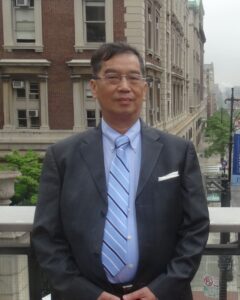
Daniel Yue has been an active investor since 1980, with experience spanning stocks, currencies, futures, metals, and bonds. A scholar of the Chicago School of Economics, he holds a Certificate with Distinction from Cambridge University and a degree in International Trading from National Taiwan University. He served as Chief Analyst for over 30 years and Chief Mentor at Sincere Finance. In 2017, he received an award from the University of Arizona for financial internship leadership.
The analysis and opinions expressed in this article are for educational purposes only and do not constitute financial advice. Investing involves risk. Please consult a qualified financial advisor before making investment decisions.
About the Author
Daniel Yue has been an active investor since 1980, with experience spanning stocks, currencies, futures, metals, and bonds. A scholar of the Chicago School of Economics, he holds a Certificate with Distinction from Cambridge University and a degree in International Trading from National Taiwan University. He served as Chief Analyst for over 30 years and Chief Mentor at Sincere Finance. In 2017, he received an award from the University of Arizona for financial internship leadership.
The analysis and opinions expressed in this article are for educational purposes only and do not constitute financial advice. Investing involves risk. Please consult a qualified financial advisor before making investment decisions.